
You notice your internet most when it slows down – during a video call, in the middle of a game update, or when the whole house is streaming at once. That is usually when the fiber vs cable internet question stops being technical and starts feeling very personal. If you are choosing service for your home or small business, the real issue is simple: which option gives you the speed and reliability you actually need at a price that makes sense?
Fiber vs cable internet at a glance
Fiber and cable can both deliver fast internet, and for many households either one can handle streaming, work, school, and smart home devices. The difference is how they get there.
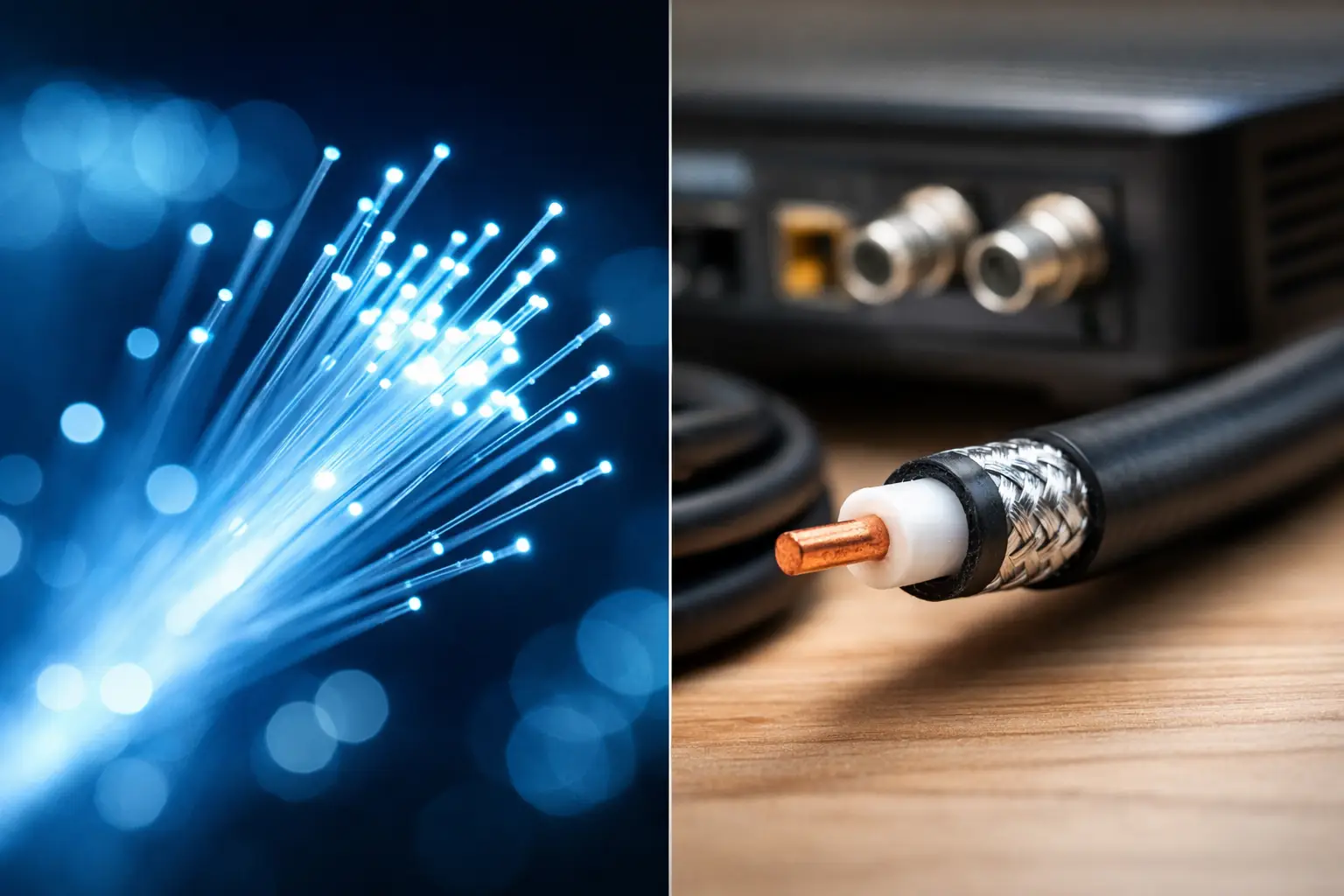
Fiber internet uses fiber-optic lines that transmit data as light. That allows for extremely high speeds, low latency, and strong consistency, especially when many devices are online at once. Cable internet typically uses coaxial cable infrastructure, often the same network used for cable TV. It is widely available and can offer excellent download speeds, but upload speeds are usually lower and performance can vary more during busy hours.
If you want the shortest answer, fiber is usually the top performer when it is available. Cable is often the more practical choice because it reaches more homes and still delivers plenty of speed for everyday use.
Speed: where fiber usually wins
When people compare internet plans, they often focus on download speed first. That matters for streaming movies, browsing, downloading files, and loading websites. In that category, both fiber and cable can be very fast.
A strong cable plan can easily support 4K streaming, online classes, remote work, and gaming for a busy household. For many families, 100 Mbps to 1 Gbps is more than enough for daily life. If your main internet habits are watching shows, scrolling social media, shopping online, and joining the occasional Zoom call, cable may already cover everything you need.
Fiber stands out because it often offers both fast downloads and fast uploads. Upload speed matters more than people realize. It affects video meetings, cloud backups, sending large files, security camera performance, and livestreaming. If you work from home, run a home business, create content, or regularly move large files, fiber can feel noticeably better.
That does not mean everyone needs fiber. A household with lighter usage may never fully use those extra upload capabilities. The best internet is not always the fastest one on paper. It is the one that fits how your household actually uses it.
Reliability and consistency
This is where the fiber vs cable internet decision often becomes more meaningful than raw speed.
Fiber is known for stable performance. It tends to hold up well during peak usage periods and is less vulnerable to certain kinds of signal interference. If you need dependable service for work, business calls, online learning, or a home full of connected devices, that consistency can be a major advantage.
Cable is also reliable for many homes, especially where the local network is well maintained. But because cable bandwidth is often shared within a neighborhood, speeds can sometimes dip when many people are online at the same time. That does not happen everywhere, and it is not always dramatic, but it is one of the trade-offs.
For a family that mainly uses the internet in the evenings, cable slowdowns may be worth considering. For a remote worker who cannot afford dropped calls or lag during business hours, fiber may feel like the safer bet.
Latency: important for gaming and video calls
Latency is the delay between sending and receiving data. Lower latency means quicker response times.
Fiber usually has lower latency than cable. That is useful for competitive gaming, real-time collaboration, video conferencing, and any task where quick response matters. If you are a gamer in a busy household, or if you spend hours each day on Teams, Zoom, or VoIP calls, fiber often delivers a smoother experience.
Cable can still work well for gaming and calls, especially on a solid local network. Many gamers use cable without major issues. But if you are sensitive to lag spikes or rely on stable connection quality for work, fiber has the edge.
Availability: where cable often wins
This is the part many comparison articles gloss over, but it matters most in real life. The better technology is only better if you can actually get it at your address.
Cable internet is more widely available across many towns, suburbs, and established neighborhoods. In areas where fiber has not been built out yet, cable may be the fastest wired option available. That makes it a strong and realistic choice for a large number of households.
Fiber availability is improving, but it is still limited in many places. Some communities have full fiber-to-the-home service, while others only have partial coverage or nearby network access. In rural and smaller regional markets, availability can vary block by block.
For customers in Southwestern Ontario and similar mixed town-and-rural areas, this matters a lot. Access depends on local infrastructure, not just preference. In many cases, the smartest move is to check what is truly available first, then compare plan speeds, pricing, and support instead of chasing a technology label.
Price and value
Fiber often carries a premium, though pricing has become more competitive in many markets. If you can get fiber at a similar monthly rate to cable, it is usually worth serious consideration because of the speed symmetry and performance advantages.
Cable is often attractive on value. You can get high speeds, unlimited data in many cases, and enough performance for a typical family without paying for capacity you may never use. For budget-conscious households, that can be the better fit.
The bigger question is not just monthly price. It is value over time. If cheaper service causes buffering, dropped meetings, or productivity issues, it may not really be cheaper. On the other hand, if an expensive fiber plan delivers benefits you barely notice, then cable may be the smarter buy.
It also helps to look beyond base pricing. Installation, promotional periods, equipment fees, and bundle options can all affect the real monthly cost.
Which one is better for your household?
The answer depends on how you use the internet.
For streaming-heavy families, cable or fiber can both work very well, provided the plan has enough speed. For remote workers, fiber is often the better long-term choice because of stronger uploads and stable video calling. For students in shared households, either option can work, but consistency becomes more important when several people are online all day. For gamers, fiber usually offers the best latency, though cable can still perform well with the right plan.
Small businesses should think carefully about upload needs, cloud tools, and reliability expectations. If your business depends on video meetings, file sharing, hosted systems, or customer communication, fiber can offer meaningful advantages. But if your operations are lighter and your local cable provider has a proven track record, cable may still deliver excellent value.
When cable is the smarter choice
Cable makes sense when fiber is unavailable, when pricing is significantly better, or when your internet use is fairly typical. If your home mostly streams, browses, shops, and checks email, you may not gain much from paying extra for fiber.
It is also a smart option when you want fast setup in an area with established cable infrastructure. Many households do not need the absolute best technology. They need dependable internet that works every day without making the decision complicated.
When fiber is worth it
Fiber is worth it when your household depends on speed and consistency, not just convenience. If several people work and learn from home, if you upload large files, if gaming performance matters, or if you want the strongest future-ready option, fiber is hard to beat.
It also makes sense for households planning ahead. Connected homes keep adding devices – smart TVs, cameras, consoles, tablets, and work laptops. Fiber gives you more room to grow without feeling cramped later.
The bottom line on fiber vs cable internet
The best choice is the one that matches your address, your budget, and your daily habits. Fiber is usually faster, more consistent, and better for heavy users. Cable is often more available, more affordable, and more than capable for many homes.
If you are comparing plans, focus less on hype and more on what you need the connection to do every day. A good provider will be clear about speeds, unlimited data, installation, and local availability. That kind of straight answer matters just as much as the technology behind the line.
For households and small businesses that want reliable internet without the runaround, that practical approach is what turns a plan on paper into service you can count on.