
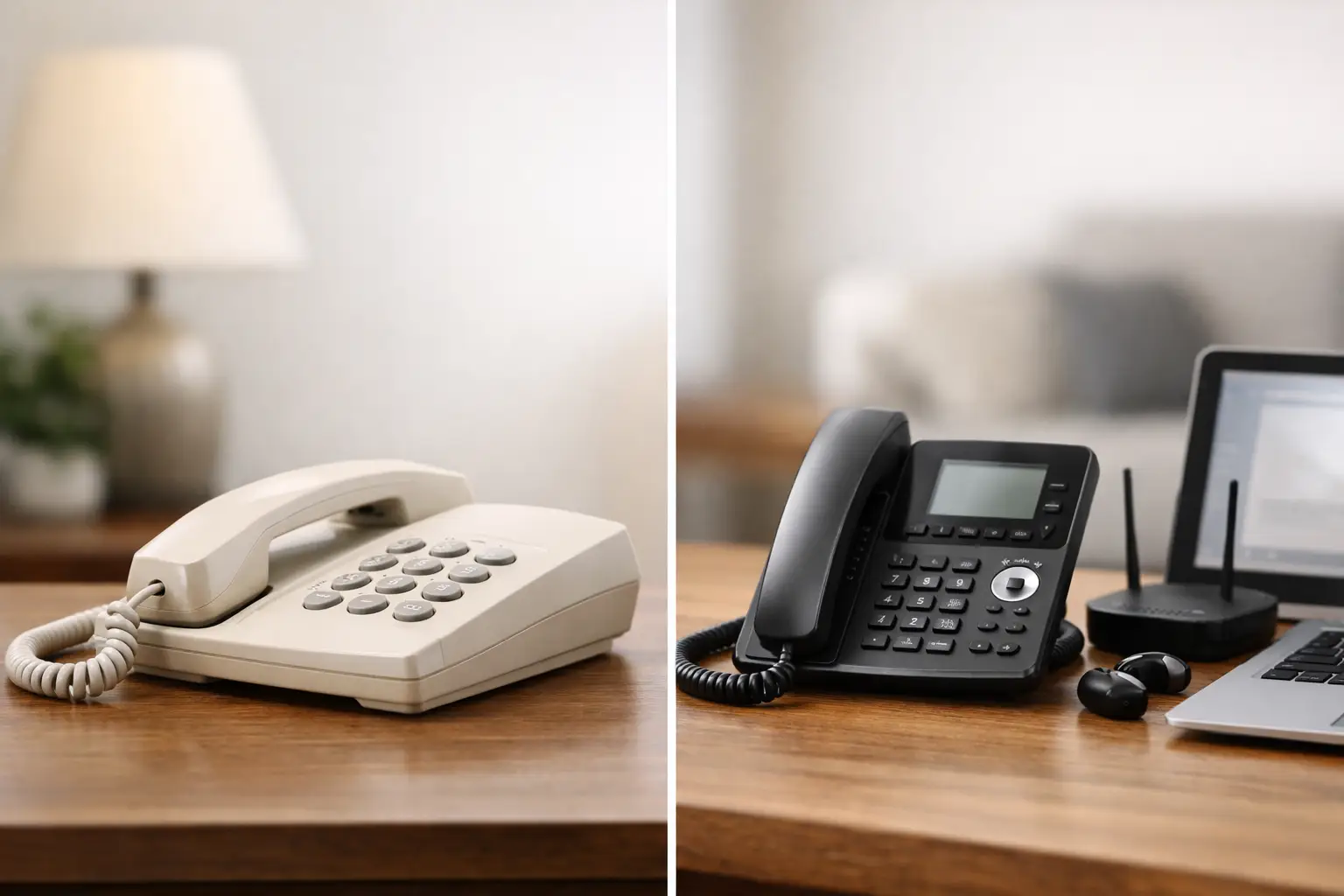
A phone line can still matter when your cell battery is low, your child is home alone, or your business needs a number customers recognize. The landline phone vs VoIP choice is less about old versus new and more about how your household or business communicates, what happens during an outage, and which features you will actually use.
For many homes across Southwestern Ontario, VoIP provides a practical, lower-cost way to keep a home phone number while gaining useful calling features. A traditional landline still has a place, especially where power-outage resilience and the simplest possible setup are top priorities. Here is how to choose with confidence.
Landline Phone vs VoIP: The Core Difference
A traditional landline, often called a plain old telephone service line, uses dedicated telephone wiring connected through the phone network. In many setups, a basic corded phone can continue working when the power goes out because the line supplies its own low-voltage power. That dependable behavior is why some households still prefer a landline for emergency use.
VoIP stands for Voice over Internet Protocol. Instead of carrying your call over a separate copper phone network, it sends voice calls through your internet connection. You can usually use a regular home phone by connecting it to a VoIP adapter or modem, so the experience feels familiar: pick up the handset, hear a dial tone, and make a call.
The difference is behind the scenes. A landline is tied to telephone infrastructure. VoIP relies on a working internet connection and equipment with power. That changes reliability considerations, available features, and often the monthly price.
Why Many Homes Choose VoIP
VoIP is designed for the way households communicate now. It can keep a familiar home phone number while making it easier to add features that used to cost extra or require separate services. Depending on the plan, those may include voicemail, caller ID, call waiting, call forwarding, long-distance options, and the ability to manage settings from an online account.
Cost is often another deciding factor. Maintaining older telephone networks is expensive, while internet-based calling can be more efficient for providers to deliver. For a family that wants a home number for relatives, school calls, appointments, or peace of mind, VoIP can offer strong value without paying for features they do not need.
VoIP also fits naturally with an internet bundle. If you already depend on high-speed internet for streaming, online classes, remote work, gaming, and smart-home devices, adding phone service to the same account can simplify billing and support. One provider, one installation conversation, and one team to call if something needs attention.
For small businesses, VoIP can be especially useful. A local number, call forwarding to a mobile device, voicemail, and flexible calling features can help a small team sound professional without investing in a complicated phone system. The right setup depends on call volume and business needs, but internet calling gives many owners more flexibility than a basic analog line.
Where a Traditional Landline Still Has an Edge
The strongest case for a traditional landline is power-outage reliability. If the line is truly copper-based and you use a corded phone, it may continue to work when household electricity is unavailable. That can be valuable in areas prone to extended outages or for households where someone needs a highly dependable way to call for help.
There is an important catch: not every service called a landline has the same outage behavior. Some modern phone services use fiber, cable, or other digital equipment, even when they are marketed as home phone service. Those services may require power at your home just like VoIP does. Before choosing, ask exactly what type of phone service is being installed and what happens if electricity goes out.
Traditional landlines are also simple. There is little equipment to manage, and a basic phone does one job well. For someone who does not want apps, account portals, or extra features, that simplicity can be a real benefit.
Still, availability is changing. In many communities, legacy copper telephone infrastructure is being reduced or replaced with newer digital networks. A traditional landline may be difficult to order in some locations, and its pricing may not compare favorably with modern home phone options.
Reliability Depends on Your Setup, Not Just the Technology
It is tempting to say that landlines are always reliable and VoIP is always dependent on the internet. The real answer is more specific.
A well-installed VoIP service paired with dependable high-speed internet can provide clear, consistent calling for everyday use. Call quality is usually excellent when the connection has enough capacity and the network is working properly. A busy home can stream, work, study, and make calls at the same time when the internet plan is sized for the household.
However, your modem, router, and VoIP equipment need electricity. During a power outage, the phone service may stop unless you have battery backup or a generator. A small uninterruptible power supply can keep essential equipment running for a limited time, but its runtime depends on the battery and the equipment connected to it. It is a useful option, not a replacement for a complete emergency plan.
Cell phones should also be part of that plan. Keep one or more devices charged, consider a portable battery pack, and make sure household members know how to place emergency calls. If you use VoIP, confirm that your service address is accurate for 911 routing, particularly after moving or changing the installation location.
Call Quality, Features, and Everyday Convenience
For most callers, sound quality will not be the deciding factor. Both a properly maintained landline and a properly configured VoIP service can sound clear. VoIP quality can be affected by internet congestion, weak Wi-Fi, damaged cables, or equipment issues. A wired connection between the modem and phone adapter can help avoid Wi-Fi-related problems.
VoIP wins on convenience when you want more control. Need calls forwarded while you are away? Want voicemail messages available without checking a physical answering machine? Need caller ID and call waiting for a busy household? These are common reasons people move to internet-based phone service.
A traditional line is best when the phone is primarily a fixed, no-frills tool. If the goal is simply to have a phone on the kitchen wall or desk that works with minimal setup, fewer features may be exactly what you want.
How to Decide for Your Household or Business
Start with the reason you want a phone line. If you rarely make calls but want a home number for family, appointments, and backup communication, VoIP is often the practical choice. It delivers familiar home-phone use with modern features and can pair neatly with your internet service.
If outage resilience is your first concern, investigate the service type carefully. Ask whether the line operates during an electrical outage, whether a battery backup is available, and whether a corded phone is required. Do not assume the word “landline” guarantees independent power.
For a rural household, reliable internet availability should lead the decision. VoIP needs a stable connection, so confirm local coverage and choose an internet plan that supports your household’s normal online activity. For a home office or small business, consider how missed calls affect your work. Features such as voicemail, forwarding, and a dedicated business number may be worth far more than the difference in monthly cost.
It also helps to consider who will use the service. Seniors may appreciate a familiar handset and simple dialing. Parents may value a shared household number. Remote workers may want a separate line that keeps personal and work calls organized. There is no one right answer, but there is usually a clear best fit once the daily use case is defined.
Questions to Ask Before You Order
Before choosing either option, get straightforward answers about monthly pricing, installation, equipment, long-distance calling, emergency calling, number transfers, and outage support. If you are moving an existing phone number, ask how long the transfer may take and whether service needs to remain active until the process is complete.
For VoIP, ask whether the provider supplies the phone adapter, whether a backup battery is available, and what internet speed or connection quality is recommended. For a traditional service, ask whether it is a true copper line or a digital home phone product. These details prevent surprises after installation.
S-Connect can help Southwestern Ontario households compare home phone options alongside high-speed internet, so you can choose a setup that works for your address, calling habits, and budget. A quick availability check is often the fastest way to turn a confusing technology decision into a practical one.
The best phone service is the one that is there when you need it, easy to use when life gets busy, and priced sensibly for the role it plays in your home or business.