

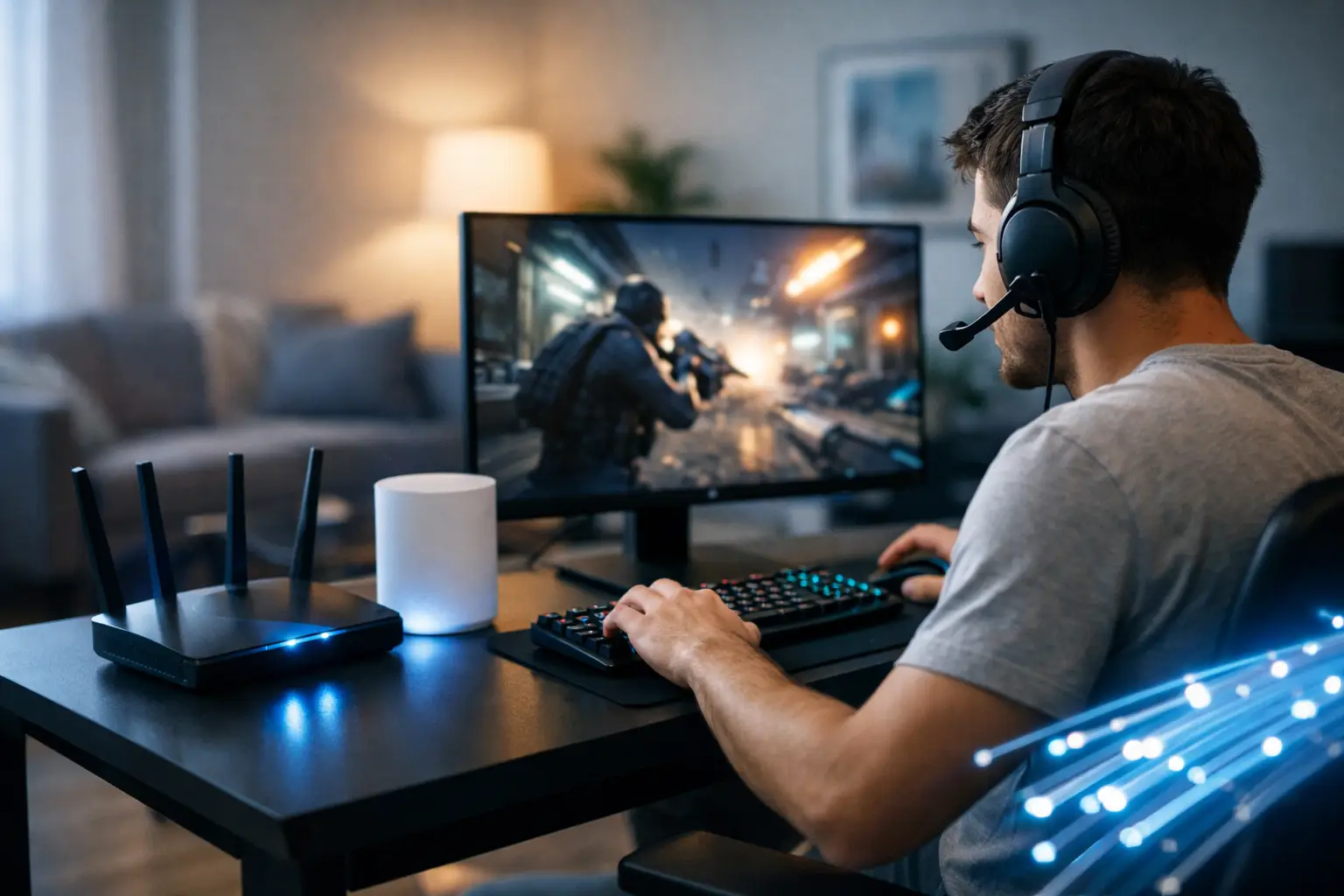
You notice bad gaming internet in the worst possible moment – right as the match tightens up, voice chat cuts out, your ping spikes, and suddenly you are reacting half a second too late. That is why fast internet for online gaming is not just about downloading a game quickly. It is about having a connection that stays steady when every second counts.
For most households, gaming performance comes down to a few basics that are easy to understand once you know what to look for. Speed matters, but it is not the whole story. A plan with strong download speeds and unlimited data helps, but low latency, reliable in-home Wi-Fi, and stable performance during busy evening hours often make the biggest difference.
What fast internet for online gaming really means
A lot of providers advertise big speed numbers because they are easy to compare. If you are downloading a 100 GB title or updating a console, those numbers absolutely matter. Higher speeds can save time and keep a busy household running when gaming, streaming, schoolwork, and remote work are all happening at once.
But when people talk about a game feeling smooth, they are usually describing latency more than raw speed. Latency, often shown as ping, is the delay between your device and the game server. Lower ping usually means faster reactions, fewer weird delays, and gameplay that feels more responsive.
That is why fast internet for online gaming should be judged by more than Mbps alone. A 1 Gbps plan sounds impressive, and for some homes it is the right fit, but a smaller plan with lower congestion and better Wi-Fi setup can still deliver a better gaming experience than a faster plan with inconsistent performance.
Speed helps, but stability wins matches
Most online games do not use a huge amount of bandwidth while you are actively playing. In many cases, the game itself uses far less data than people expect. The heavy internet use often comes from everything around the game – downloads, updates, livestreams, cloud saves, voice chat, and other people in the house watching 4K video or joining video calls.
This is where plan selection becomes practical. If one person games casually and the rest of the home has light internet use, 100 Mbps may be enough. If several people are online at the same time, or if your home regularly streams, works remotely, and downloads large files, moving up to 300 Mbps, 500 Mbps, or even 1 Gbps can create more breathing room.
The trade-off is simple. Paying for more speed than you use is unnecessary, but choosing a plan that is too small for your household can create slowdowns at the exact times you want reliable performance. A gaming-ready connection is not just about the gamer. It is about the whole home staying connected without fighting over bandwidth.
Latency, jitter, and packet loss matter more than most people think
If you only remember one thing, make it this: low ping beats flashy marketing every time.
Latency is the travel time between your device and the game server. Jitter is the variation in that travel time. Packet loss happens when some data does not arrive properly. Together, these are often the real reason for rubber-banding, delayed shots, frozen moments, and voice chat issues.
A household can have plenty of speed on paper and still run into gaming problems if the connection is unstable. That is why a reliable provider, strong local network coverage, and a well-placed modem or router matter so much. The goal is not just speed tests that look good in the afternoon. The goal is consistent performance when everyone gets online at night.
The best internet setup for gaming inside your home
Even the right plan can feel slow if your home setup is working against you. In many cases, the issue is not the internet line coming into the house. It is the way the connection reaches your gaming device.
A wired Ethernet connection is usually the best option for serious gaming. It reduces interference and tends to deliver a more stable connection than Wi-Fi. If your console or PC is close enough to your modem or router, plugging in directly is often the easiest upgrade you can make.
If Wi-Fi is your main option, placement matters. Keep the router in a central, open area rather than tucked behind a TV, inside a cabinet, or in the basement corner. Walls, distance, and even household electronics can weaken the signal. Newer Wi-Fi equipment can improve coverage, but the biggest benefit usually comes from better placement and matching the setup to the size of the home.
In larger houses, especially where multiple people are online across different rooms, dead zones can hurt gaming performance more than people expect. That is where upgraded hardware or a whole-home Wi-Fi approach can help. The best result is not just strong signal bars. It is dependable coverage where you actually play.
How much speed do gamers actually need?
The honest answer is: it depends on the household.
For a single gamer in a lighter-use home, 100 Mbps can be enough for smooth online play, updates, and some streaming. For a family with multiple devices running at once, 300 Mbps or more is often a more comfortable choice. If your household is packed with streamers, remote workers, students, smart home devices, and gamers all sharing the same connection, 500 Mbps to 1 Gbps can make everyday use feel much easier.
Upload speed also deserves more attention than it gets. If you stream gameplay, post content, use cloud gaming services, or spend time on video calls between matches, stronger upload performance can help keep things responsive.
This is also why unlimited data is such a practical feature. Modern games are huge, updates arrive constantly, and a connected home can burn through data fast. Nobody wants to watch usage caps while installing a new release or updating multiple systems in one month.
Fast internet for online gaming in rural and small-town areas
Gamers outside major metro areas often assume they have to settle for poor performance. That is not always true.
In rural and small-town communities, the key is finding a provider that understands local infrastructure, coverage realities, and what households actually need. Availability can vary street by street, and the best option is not always the one with the loudest national ad campaign. Local support, honest installation guidance, and access to cable, fiber-adjacent, or rural internet options can make a major difference.
For homes in places like Stratford, Listowel, London, Mitchell, and surrounding Southwestern Ontario communities, the right provider should be clear about what speeds are available at your address and what kind of experience you can expect. That practical approach matters more than vague promises.
This is where a regional provider like S-Connect can fit well for households that want modern speeds, unlimited data, and straightforward help choosing the right package without unnecessary jargon.
Choosing a gaming-friendly internet plan
When comparing plans, it helps to think beyond the headline number. Ask whether the connection gives you enough speed for the whole household, whether unlimited data is included, and whether the provider has a reputation for dependable service during peak use times.
Also think about your own habits. A competitive PC gamer with a wired setup has different needs than a family with two consoles, three smart TVs, school laptops, and constant mobile device use. There is no single perfect plan for everyone.
A practical choice is the one that matches how your home actually uses the internet today, with enough room for tomorrow. Games keep getting bigger, households keep adding devices, and a connection that feels fine now may feel cramped sooner than you think.
The right gaming internet should feel boring in the best way. No sudden lag spikes, no dropped voice chat, no family arguments over who is using all the bandwidth. Just reliable speed, unlimited usage, and enough consistency to let you focus on the game instead of the connection.
If your current setup keeps getting in the way, it may not take a dramatic change to fix it. Sometimes the answer is a faster plan. Sometimes it is better Wi-Fi placement or a wired connection. And sometimes it is simply choosing a provider that treats reliable local service like it actually matters. That is the kind of upgrade you feel every time the match starts.